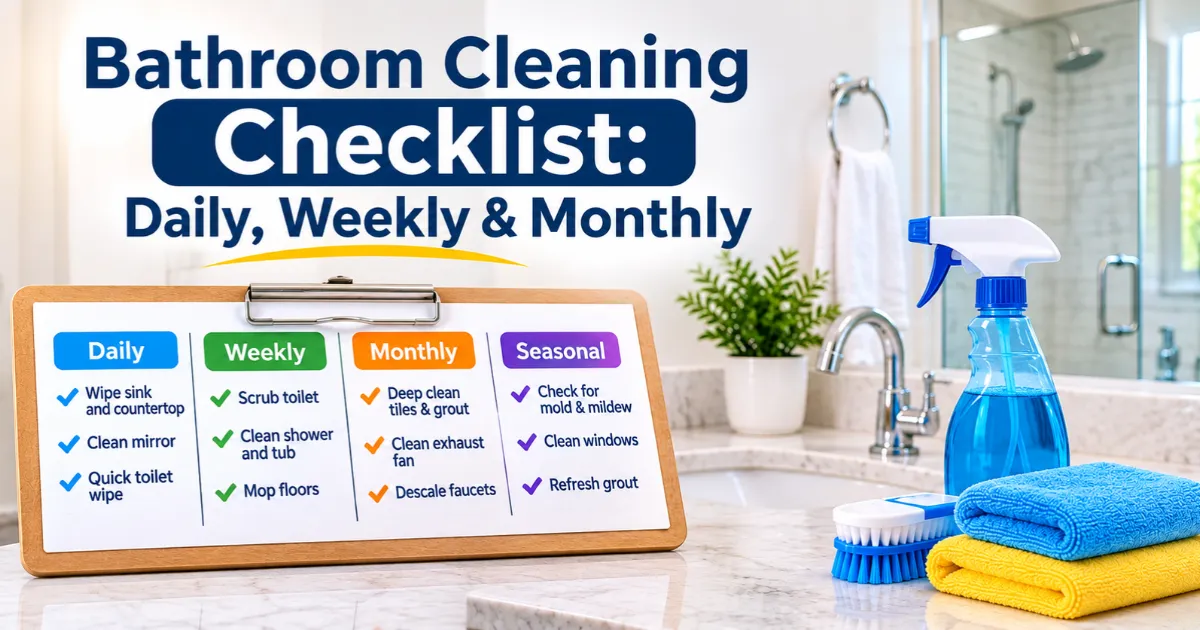
A good bathroom cleaning checklist has four layers: a two-minute daily reset, a 30–45 minute weekly clean done top to bottom with the toilet last, a monthly round for the spots people forget (grout, showerhead, fan cover, drains), and a deeper clean every season. Keep to that rhythm and the bathroom never gets bad enough to need a scrubbing marathon.
This checklist is written for California homes, where hard water, dry heat, and fast-evaporating water spots change what clean takes. You’ll get the tasks, the order to do them in, which products to keep away from which surfaces, and how to tell when it’s time to call someone in.
The quick version
- Daily (2–5 minutes): squeegee the shower, wipe the sink, hang towels, run the fan.
- Weekly (30–45 minutes): dust high, pre-treat, then mirror, sink, shower, high-touch spots, toilet, floor.
- Monthly: descale the showerhead, scrub grout, wash the liner and fan cover, check under the sink.
- Seasonal: re-caulk if needed, deep-scrub grout, clean behind the toilet and the walls, replace worn tools.
What You Need Before You Start
A small caddy saves more time than any cleaning hack. Stock it once and carry it room to room.
- All-purpose or bathroom cleaner
- A disinfectant (check the label for an EPA registration number)
- Glass cleaner
- Toilet bowl cleaner and a brush
- Non-scratch sponge or scrub pad
- Soft brush or old toothbrush for grout and drains
- Microfiber cloths, with a separate set for the toilet
- A squeegee
- Rubber gloves
- A vacuum or broom, and a mop
Two rules make everything below work better.
- Clean first, then disinfect. Dirt blocks disinfectants from doing their job. CDC guidance is to clean a dirty surface with soap and water, then apply the disinfectant and keep the surface visibly wet for the contact time printed on the label. Skipping the cleaning step or wiping the product off early is the usual reason disinfecting doesn’t work.
- Never mix cleaning products. Bleach combined with ammonia or with acids such as vinegar can release toxic gases. Use one product at a time, rinse the surface between products, and open the door or run the fan.
Daily Bathroom Cleaning Checklist (2–5 Minutes)
Daily jobs don’t scrub anything. They remove water, which is what soap scum, mildew, and mineral spots need to form.
- Squeegee the shower walls and glass after the last shower of the day.
- Wipe the sink and faucet with a damp cloth. Toothpaste is easiest to remove before it dries.
- Hang towels spread out and hang the bath mat so both dry fully.
- Put things back on the counter so the wipe-down takes ten seconds.
- Run the exhaust fan during the shower and for a while afterward, around 30 minutes if you can.
Add a quick toilet swish or empty the trash only if it needs it.
Weekly Bathroom Cleaning Checklist (30–45 Minutes)
The order matters more than the brand of cleaner. Work top to bottom so falling dust lands on surfaces you haven’t cleaned yet; dry before wet, and cleanest to dirtiest, which puts the toilet last. Start the jobs that need dwell time first, then do other tasks while they sit.
- Clear the room. Take out the trash, used towels, and the bath mat. Move everything off the counter and tub edge.
- Dust high. Wipe the vent cover, light fixtures, mirror frame, and tops of cabinets with a dry or barely damp microfiber cloth. Doing this before any spraying keeps dust from turning into streaks.
- Pre-treat. Squirt toilet bowl cleaner under the rim and spray the shower or tub walls with your bathroom cleaner. Leave both to work for the time on the label.
- Mirror. Spray glass cleaner onto the cloth, not the mirror, and wipe top to bottom. Buff dry.
- Counter, sink, and faucet. Spray, wipe, rinse, and dry. Dry the faucet with a clean cloth, and the chrome will stay spot-free. Pull any hair from the drain stopper.
- Shower or tub. Scrub the pre-treated surfaces, rinse, and squeegee the glass. Wipe the door track, where mildew starts first.
- High-touch spots. Flush handle, faucet handles, light switch, doorknob, and cabinet pulls. If you disinfect, keep them wet for the label’s contact time.
- Toilet last. Scrub the bowl. Then wipe the seat, hinges, lid, tank, the outside, and the base where it meets the floor, using a separate cloth.
- Floor. Sweep or vacuum, then mop from the far corner back toward the door. Get behind the toilet and along the edges.
- Restock. Fresh towels and mat, toilet paper, hand soap.
Realistic time: about 30–45 minutes for one standard bathroom, longer if a week or two got skipped. These are planning estimates, not lab numbers.
Monthly Bathroom Cleaning Checklist
These are the jobs that don’t show until they’re a problem. Do them once a month, on top of the weekly clean.
- Descale the showerhead and faucet aerators. Fill a bag with white vinegar, secure it around the showerhead, and leave it for 30 minutes to a few hours. Check your fixture’s finish first, because long vinegar soaks can dull some brass, nickel, and oil-rubbed finishes.
- Scrub the grout lines with a baking soda paste and a soft brush.
- Wash the shower curtain liner following its care label, or replace it if mildew has set in.
- Wash the exhaust fan cover. Switch the power off first, then wash the cover in soapy water, dry it fully, and refit it.
- Wipe inside the vanity and under-sink cabinet, and look for drips or damp spots around the supply lines and the toilet base.
- Wash baseboards, the door frame, and the wall beside the shower.
- Wash bath mats and rinse out the trash can.
- Check the caulk along the tub, shower, and sink for gaps, cracks, or dark spots.
- Toss expired products and anything you haven’t used in a year.
Seasonal Deep Clean Checklist (Every 3 Months or As Needed)
A seasonal clean resets the baseline so the weekly clean stays quick.
- Re-caulk where it’s cracked, peeling, or stained. Remove the old caulk and let the area dry completely first, since new caulk won’t hold on a damp surface.
- Deep-scrub grout, and ask whoever installed your tile whether the grout should be sealed.
- Clean behind and around the toilet, including the bolt caps and the seam at the floor.
- Wash the walls and ceiling near the shower. Mildew often shows on the ceiling first.
- Clean the window and its track.
- Empty and wipe every cabinet and drawer.
- Replace worn tools: the toilet brush, sponges, loofahs, and the shower liner.
- Test the exhaust fan. Hold a single square of toilet paper to the grille while the fan runs. If it doesn’t stay put, the fan or duct needs attention.
A deep clean usually takes around 1.5 to 2 hours for one bathroom, depending on how much buildup there is.
How Often Should You Clean a Bathroom?
Once a week is the baseline for a bathroom used every day. Your household changes that.
Situation | Suggested rhythm |
One or two adults, daily use | Weekly clean, daily reset |
Family bathroom with kids | Weekly clean, plus toilet and floor mid-week |
Guest bathroom, rarely used | Every 1–2 weeks: dust, wipe, flush |
Short-term rental | Full clean after every stay |
Someone in the home is sick | Disinfect high-touch spots daily until they’re better |
The California Factor: Hard Water, Dry Heat and Mineral Spots
Hard water carries dissolved calcium and magnesium. Many Southern California and inland communities, the Coachella Valley included, have water that ranges from moderately hard to hard according to local water districts. When that water dries, and it dries fast in a hot, dry climate, the minerals stay behind as white crust on faucets, cloudy glass, and scale inside the showerhead.
That changes the checklist in a few ways:
- Squeegee and dry the glass every day. Most of those spots are minerals, not dirt, so scrubbing harder rarely helps.
- Descale monthly, more often if the aerators clog or the spray pattern goes uneven.
- Use an acidic descaler such as vinegar or a citric-acid product on glass, chrome, and glazed tile, and keep it off natural stone (see the table below).
- Check your water utility’s annual water quality report to see how hard your local water is.
- Don’t skip the fan because the air is dry. A closed bathroom still holds shower steam, and an interior bathroom with no window and a weak fan is where mildew shows up.
Which Cleaner on Which Surface
Most bathroom damage comes from the right product on the wrong surface. Spot-test and follow the manufacturer’s care instructions where you have them.
Surface | Safe go-to | Avoid |
Natural stone (marble, travertine, limestone) | pH-neutral stone cleaner and a soft cloth | Vinegar, lemon, acidic descalers, abrasive powders, which can etch the stone |
Glazed ceramic or porcelain tile | All-purpose or tile cleaner, soft brush | Steel wool |
Cement-based grout | Baking soda paste, grout cleaner | Repeated harsh acids, which can wear it down |
Fiberglass or acrylic tub | Non-abrasive bathroom cleaner | Scouring powders and pads, which leave scratches that trap dirt |
Glass shower doors | Glass cleaner or a vinegar-and-water mix, then a squeegee | Abrasive pads |
Chrome, nickel, brass, oil-rubbed bronze | Mild soap and water, soft cloth | Long acid soaks, abrasive scrubbers |
Common Bathroom Cleaning Mistakes
- Disinfecting a dirty surface. Clean first, then disinfect.
- Using one cloth for the toilet and the sink. Keep a separate set for the toilet.
- Spraying and wiping straight away. Cleaners need dwell time to loosen buildup.
- Mopping first. The floor goes last, because everything above it drops dust and drips.
- Using vinegar on everything. It’s fine on glass and chrome, but not on stone.
- Scrubbing scale. If it’s white and crusty, it’s minerals. Descale it.
- Skipping the fan. Moisture is the root of most bathroom mildew.
- Mixing products. One at a time, rinse between.
How to Keep Mold and Mildew From Coming Back
EPA’s guidance puts it simply: the key to mold control is moisture control. Dry wet surfaces within 24 to 48 hours, and fix the source of any leak. In a bathroom, that comes down to habits:
- Run the fan during and after showers.
- Squeegee the glass and walls.
- Hang towels and mats so they dry fully.
- Fix drips and sweating pipes quickly.
For a small patch of mold on a hard surface, EPA advises scrubbing with detergent and water and drying the area completely. Bleach isn’t required for routine cleanup. If growth keeps returning, spreads across a large area, shows up after a leak, or you notice a musty smell with no visible source, find the moisture source first, and bring in a plumber or a mold professional.
When to Hand the Checklist to a Professional
A checklist works when the starting point is reasonable. Some bathrooms aren’t there yet. Consider a professional deep clean if you’re dealing with:
- Heavy hard water scale that descaling hasn’t touched
- Grout that’s stained all the way through
- Soap scum layered over months
- A move-in, move-out, or a rental turnover on a deadline
- Several bathrooms and not enough weekends
A one-time deep clean resets the bathroom. After that, the daily and weekly lists keep it there, and it takes far less effort than starting from scratch.
If you’d like that reset done for you, contact Agape Cleaning Services to book a deep clean or ask for a quote. We’re based in Palm Desert, California.
Bathroom Cleaning Checklist FAQs
Add Your Heading Text Here