
A restaurant owner in Fresno once told me she got four quotes for the exact same kitchen, same square footage, same equipment, same grease trap horror show behind the fryer station, and the numbers came back so far apart she assumed someone had misread the address. One bid landed at $180. Another came in north of $700. Same kitchen. Same night. Four completely different numbers.
That’s not a fluke. That’s the honest, slightly maddening reality of figuring out commercial kitchen cleaning cost in California, and if you’ve been collecting quotes and feeling like you’re comparing apples to fire extinguishers, you’re not imagining things.
California doesn’t make this easy. Between the state’s wage floor, county-level health codes, coastal humidity that turns grease into something closer to concrete, and a labor market where a cleaner in Fresno costs meaningfully less than the same worker three hours west in San Francisco, there’s no single number that applies to your kitchen. There’s only a range, and a set of variables that push you toward one end of it or the other.
This guide walks through what actually drives commercial kitchen cleaning cost in California, what you should expect to pay depending on where you operate and what kind of kitchen you’re running, and how to tell a fair quote from a bloated one — or worse, a suspiciously cheap one that’s about to leave your hood vents untouched and your health inspector unimpressed.
Ask a commercial cleaner in Ohio what a kitchen cleaning costs, and you might get a straightforward per-square-foot number. Ask the same question in California, and a good cleaner will pause, then start asking you questions instead: How many line items on the equipment list? What’s your grease load like? Are you slammed seven nights a week or do you close on Mondays? Is this a walkable strip mall kitchen or a downtown high-rise with a loading dock, a freight elevator, and a security desk that wants everyone badged in by 9pm?
That back-and-forth isn’t a stalling tactic. It’s the job. A kitchen’s size tells you almost nothing about how long it takes to clean. Two 1,800-square-foot kitchens can require wildly different labor hours depending on how much grease has built up on the hood interior, how tightly the equipment is packed together, and whether the floor is quarry tile that grips grime like it’s personally offended by cleanliness.
Here’s where things get regionally specific. California’s minimum wage sits well above the federal floor, and several cities, San Francisco chief among them, layer on their own local minimums that push even higher. Add mandatory sick leave, workers’ comp requirements that are stricter than most states, and insurance premiums that reflect California’s litigation-friendly climate, and you start to understand why a crew here simply costs more to put in your kitchen than the same crew would cost in, say, Boise.
Then there’s humidity and coastal air. Kitchens near the water- Santa Barbara, San Diego, the Bay Area- deal with grease and grime that behaves differently than it does in the dry Central Valley heat. Moisture keeps grease softer longer in some ways, but it also means mold and mildew become real considerations in walk-ins and storage areas, adding tasks that inland kitchens might not need as often.
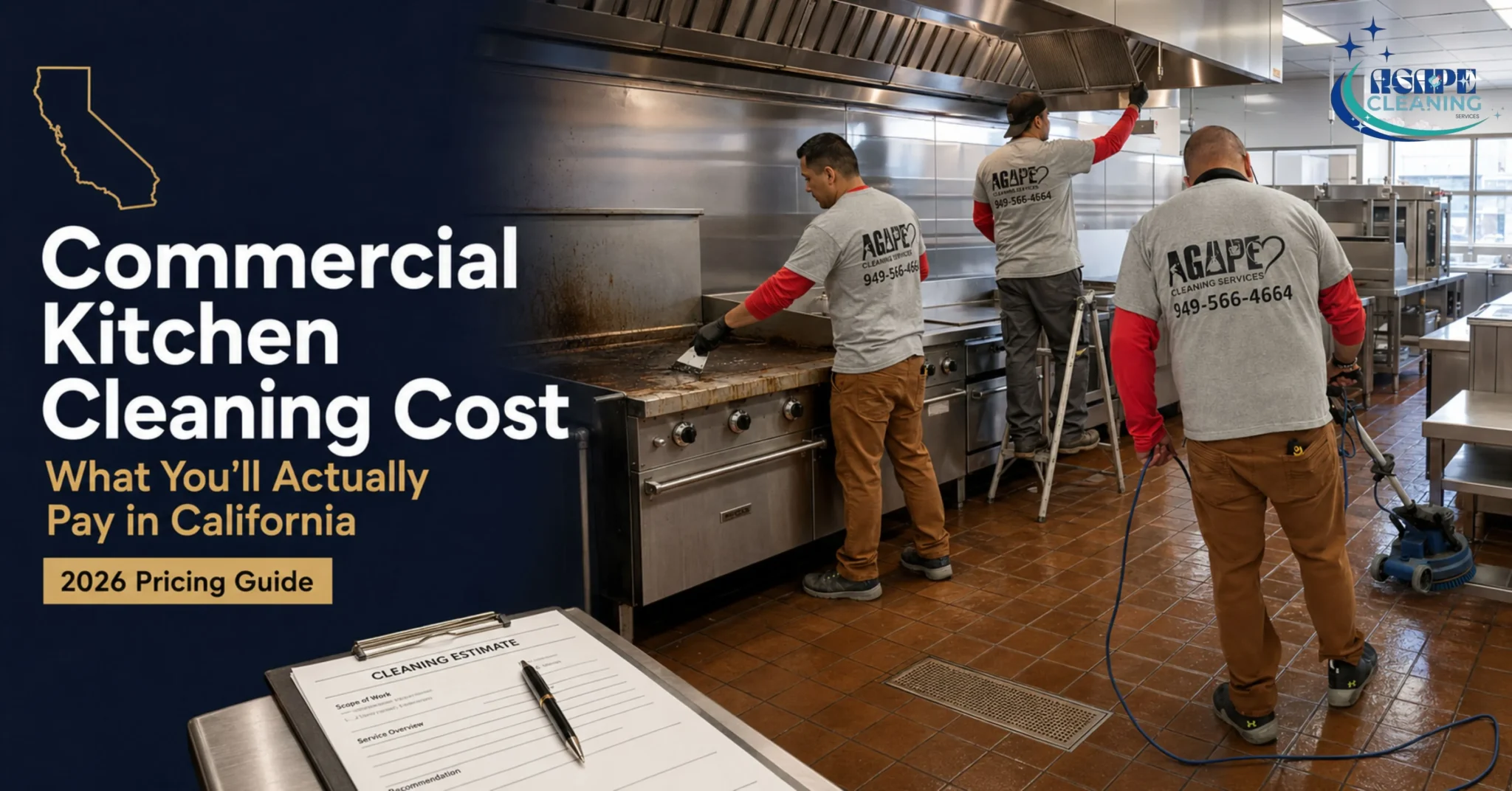
If you remember nothing else from this guide, remember this: square footage is the least useful number in the whole conversation. It’s the first thing every quote mentions and the last thing that should determine your budget.
Here’s what actually moves the needle.
Yes, size matters, but it’s about zones, not raw square feet. A cleaning crew isn’t just wiping down open floor space. They’re working through the cook line, the prep area, the dish pit, walk-in coolers, dry storage, receiving docks, and sometimes employee break areas. A compact 1,200-square-foot kitchen crammed with six pieces of equipment and a tight dish pit can take longer than a sprawling 2,500-square-foot kitchen with an open layout and fewer obstacles.
This is the one that catches new restaurant owners off guard almost every time. If your kitchen hasn’t had a proper deep clean in a while, maybe you inherited the space from a previous tenant, or maybe things have just slipped for a few months during a staffing crunch, your first cleaning is going to cost more than every cleaning after it.
Think of it like a dentist appointment after five years of avoiding the dentist. The first visit involves work that simply isn’t needed once you’re back on a normal schedule. A reputable company will separate this initial reset cost from your ongoing maintenance price, so you’re not stuck assuming your monthly cleaning bill will always look like that first invoice. If a company doesn’t make that distinction, ask them to.
A restaurant doing three dinner services a week generates a fraction of the grease and food debris that a full-service spot open seven days generates. Frequency and soil load are directly connected; the less often you clean, the harder (and more expensive) each individual cleaning becomes, because grease compounds. It doesn’t just sit there waiting patiently; it bakes onto surfaces every time a burner fires up.
Can the crew get in at 11 pm and be gone by 5 am without disrupting prep? Or are they working around a hotel kitchen that never fully closes, phasing through sections while breakfast service continues three rooms over? Downtown buildings with security check-ins, freight elevator schedules, or union access rules add real time, and real cost, before a single degreaser bottle gets opened.
Stainless steel cleans differently than quarry tile. Quarry tile cleans differently than a sealed concrete floor. A kitchen with six pieces of equipment crammed into a small footprint takes longer to clean around than the same square footage with an open layout. None of this shows up in a quick square-footage estimate, which is exactly why square-footage-only quotes tend to be the least reliable ones you’ll receive.
This might be the single biggest source of confusion in the entire industry. Full kitchen cleaning means different things to different companies. Some quotes include interior hood cleaning. Some don’t touch the hood at all and expect you to hire a separate certified hood-cleaning vendor (which, for what it’s worth, is often the correct approach; hood and exhaust system cleaning is a specialized, fire-code-driven service that deserves its own line item and its own certified technician). Ask directly: does this include grease trap service? Walk-in interiors? Wall washing behind equipment? The answers change the price more than almost anything else on this list.
California doesn’t have one commercial cleaning market. It has several, and treating them as interchangeable is how business owners end up either overpaying or getting a bid so low it should raise questions. If you’re trying to pin down commercial kitchen cleaning cost in California for your specific city, the region you’re in matters just as much as the kitchen itself.
This is the most expensive corner of the state, and it’s not close. San Francisco’s minimum wage sits above $19 an hour, and that’s before accounting for benefits, workers’ comp, and the extra logistics of getting a crew into a downtown high-rise after hours, parking, security clearance, elevator access, and sometimes union protocols in older buildings.
For a mid-sized kitchen cleaned multiple times a week, expect cost-per-clean in the neighborhood of $250 to $400+, with monthly contracts for busier operations easily running into four figures. A standard commercial rate in the Bay tends to land around $0.14 to $0.30 per square foot on the janitorial side, and kitchen work, being more labor-intensive than office cleaning, sits at the higher end of whatever range a provider quotes.
San Diego runs a notch behind the Bay Area but is still meaningfully pricier than most of the country, largely for the same reasons: California’s labor and insurance requirements apply statewide, and coastal, high-density areas add parking and access friction that inland areas don’t have. Hourly commercial cleaning rates in San Diego typically fall between $40 and $70 per hour, with monthly contracts for standard commercial spaces ranging from roughly $1,600 up into the five figures for large, multi-zone facilities. Restaurant and hospitality kitchens, because of grease load and health-code stakes, tend to sit toward the top of whatever bracket a building type falls into.
LA’s market is enormous and genuinely varied, which makes it tricky to pin down. A quick-service kitchen in the San Fernando Valley is going to get a very different quote than a full-service restaurant kitchen in a high-rise near downtown. As a general anchor point, hourly commercial cleaning in LA tends to run $50 to $75 per hour, with kitchen-specific deep cleans commanding a premium over standard janitorial work because of the grease, food safety, and equipment-handling skill involved.
Here’s some good news if you’re inland: labor costs, real estate, and general overhead all run lower than the coast, and that shows up in your cleaning bill. Rates here tend to track closer to national averages, often $35 to $55 per hour for standard commercial kitchen work, though the gap narrows for specialty deep cleans, since degreasers, sanitizers, and skilled labor cost roughly the same wherever the truck is parked.
Orange County splits the difference between LA-adjacent pricing and the more moderate Central Valley numbers, generally landing in the $40 to $65 per hour range for kitchen work, with coastal properties (again, parking, access, sometimes environmental regulations tied to proximity to the water) pushing toward the higher end.
Reading through six paragraphs of regional detail is useful, but sometimes you just want the numbers side by side. Here’s how commercial kitchen cleaning cost in California breaks down by region:
| Region | Hourly Rate | Cost Per Clean (Mid-Size Kitchen) | Monthly Contract Range | Why It Costs What It Costs |
|---|---|---|---|---|
| San Francisco Bay Area | 45–65/hr | 250–400+ | 1,300–3,500+ | Highest minimum wage in the state, high-rise access logistics, downtown parking |
| San Diego | 40–70/hr | 220–380 | 1,600–5,000+ | Coastal labor costs, building security, parking constraints |
| Los Angeles | 50–75/hr | 230–400 | 1,500–4,500+ | Market size and variability, premium for grease-heavy full-service kitchens |
| Orange County | 40–65/hr | 200–350 | 1,200–3,000 | Splits the difference between LA and inland pricing |
| Sacramento / Central Valley | 35–55/hr | 150–280 | 900–2,200 | Lower real estate and labor overhead than coastal metros |
Figures reflect typical ranges for standard commercial kitchens cleaned multiple times weekly. First-time deep cleans, heavy grease loads, and hood/exhaust work are priced separately and will push these numbers higher.
Understanding the method behind a quote helps you evaluate whether it’s fair, and it also helps you ask better questions when a number seems off.
Common for one-time deep cleans or kitchens where the scope isn’t fully known yet. You’re paying for labor hours, plain and simple, which means efficiency matters. A slower crew costs you more even if their hourly rate looks competitive on paper.
Once a provider has walked your kitchen and understands the scope, most will move you to a flat per-visit or monthly rate. This is genuinely the better option for ongoing service; it protects you from surprise overages and gives the cleaning company an incentive to work efficiently rather than stretch the clock.
Useful as a rough starting point, less useful as a final number for kitchens specifically, for all the reasons covered above. A restaurant kitchen and a quiet back-office break room might share a square footage number and nothing else about their cleaning needs.
Typically reserved for investigative or restoration-style work, think a kitchen that’s been neglected for months and nobody’s entirely sure what’s under that equipment until someone actually moves it.
| Pricing Model | Best For | Pros | Watch Out For |
|---|---|---|---|
| Hourly | One-time or first-time deep cleans, unclear scope | Simple, transparent, no risk of overpaying for unused scope | Slower crews cost you more; hard to budget in advance |
| Flat Rate (Per Visit) | Ongoing weekly or monthly service | Predictable, protects against overages, incentivizes efficiency | Requires an accurate walkthrough upfront to avoid underpricing |
| Per Square Foot | Rough initial estimates, comparing providers quickly | Fast to calculate, easy to compare on paper | Doesn’t account for grease load, equipment density, or zone complexity |
| Time and Materials | Restoration jobs, unknown or neglected kitchens | Fair when true scope can’t be known upfront | Costs can climb if not capped or checked in regularly |
If there’s one section of this article worth bookmarking, it’s this one. These are the costs that show up after the initial quote, usually because they weren’t clearly scoped in the first conversation.
Ask every provider to mark each of these as included, excluded, or separately priced before you sign anything. It’s a two-minute conversation that saves you from a very unpleasant invoice later.
It’s tempting to just take the lowest number. Nobody enjoys spending more than they have to, and restaurant margins are thin enough already. But here’s the honest truth from anyone who’s actually worked in this industry for a while: an unusually low bid almost always means something is missing from the scope, not that you found a hidden gem.
Maybe the hood interior isn’t actually included. Maybe the crew is smaller than it should be, which means the job either takes longer than promised or gets rushed through. Maybe there’s no real insurance behind the company, which is a problem you really don’t want to discover after someone gets hurt on your equipment. A health inspector doesn’t care that your cleaning bid was a great deal; they care whether the kitchen passes, and a rushed, underscoped clean has a way of showing up exactly where inspectors like to look.
By this point, you’ve probably noticed that commercial kitchen cleaning cost in California isn’t a fixed number you can look up once and forget; it shifts with your city, your equipment, and how honestly each bidder scoped the job. The good news is that comparing quotes gets a lot easier once you know what questions to ask.
Yes. San Francisco’s high minimum wage and complex building-access logistics both contribute to higher commercial kitchen cleaning costs.
Usually not. Commercial hood and exhaust cleaning is typically provided as a separate, certified service.
The first cleaning may need to remove years of accumulated grease and buildup. After this initial reset, predictable maintenance pricing can usually be applied.
Flat-rate pricing can protect you from unexpected overages once the cleaning provider understands your kitchen’s size, condition, and service requirements.