If you run a restaurant, food truck, cloud kitchen, or catering business in California, you already know that a dirty kitchen isn’t just bad for business; it can shut you down. This commercial kitchen cleaning guide for California operators walks through exactly what health inspectors look for, how often you should be cleaning each area, and when it’s smarter to bring in a professional cleaning crew instead of doing it all yourself.
We’ve put this together based on what we actually see on the ground at Agape Cleaning Service, cleaning commercial kitchens across California for restaurants, hotels, schools, and food production facilities. This isn’t recycled advice; it’s what works in real kitchens, under real health inspections.
Commercial kitchen cleaning is the routine and deep sanitation of all food-contact surfaces, equipment, floors, walls, ventilation systems, and storage areas in a professional food service environment, done to meet California Retail Food Code (CalCode) and local county health department standards. A properly cleaned commercial kitchen follows a layered schedule: daily tasks (surfaces, floors, dishwashing), weekly tasks (deep equipment cleaning, walk-ins), and monthly/quarterly tasks (hood systems, drains, deep degreasing).
Key takeaway: California kitchens are held to some of the strictest food safety standards in the country. Skipping deep cleaning doesn’t just risk a bad inspection score; it risks fire hazards, pest infestations, and closure.
Commercial kitchen cleaning isn’t the same as wiping down a countertop at home. It covers every surface and system that touches food, air, or people in a working kitchen, including:
Each of these has different cleaning frequencies, products, and inspection criteria, which is exactly where most kitchens fall behind.
California kitchens operate under the California Retail Food Code (CalCode), enforced at the county level (LA County, San Diego County, Orange County, etc. each run their own inspection programs under the same base code). A few things every operator should know:
Disclaimer: Health codes vary by county and change periodically. This guide reflects general CalCode standards as commonly enforced across California counties; always confirm current requirements with your local health department before an inspection.
Here’s how a well-run California commercial kitchen typically structures its cleaning schedule:
Frequency | Tasks | Why It Matters |
Daily | Wipe/sanitize prep surfaces, sweep & mop floors, empty trash, clean dishwashing area, sanitize handwash sinks | Prevents bacteria growth and cross-contamination |
Weekly | Deep-clean fryers, degrease range hood exteriors, clean walk-in cooler shelving, scrub floor drains | Stops grease buildup before it hardens |
Monthly | Clean behind/under heavy equipment, wash walls near cooking lines, deep-clean ice machines | Targets areas inspectors specifically check |
Quarterly | Full hood and exhaust duct cleaning (per NFPA 96), deep degreasing of ventilation systems | Reduces fire risk, required for compliance |
Real-world example: A mid-size California diner we work with was passing daily inspections fine but kept getting dinged on hood grease. The fix wasn’t more daily cleaning; it was adding quarterly professional hood cleaning to the schedule, since grease inside ductwork isn’t something mops and degreasers reach.
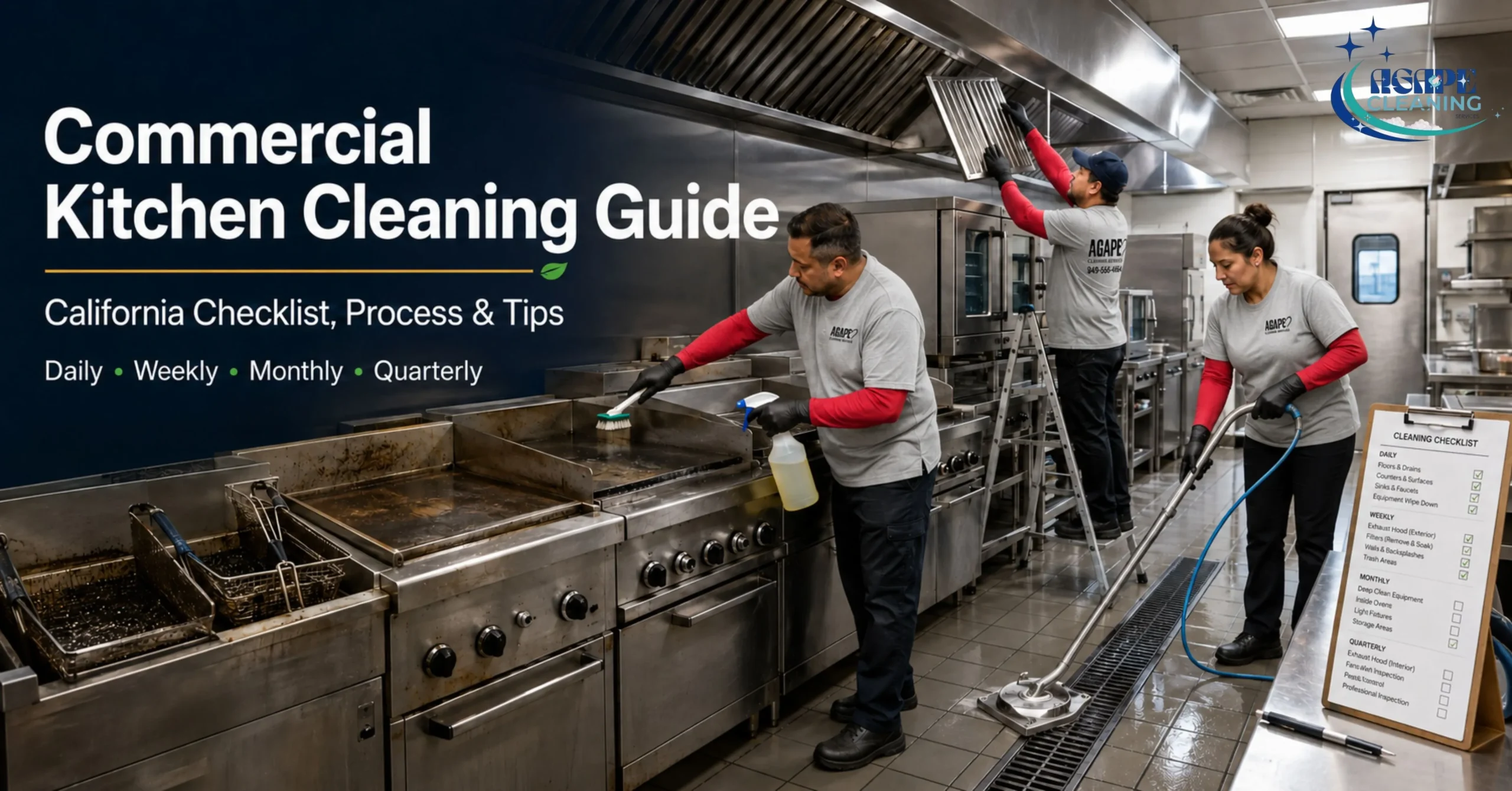
This is the part most kitchens underestimate. Grease-laden vapors travel through your exhaust hood and ductwork every time you cook. Over time, that grease builds up inside the ducts, not just the visible hood, and becomes a serious fire hazard.
Under NFPA 96, most commercial kitchens need professional hood and duct cleaning every 3 to 6 months, depending on cooking volume (a 24-hour fry-heavy kitchen needs it more often than a light-prep café). This typically requires specialized equipment and access panels that go beyond a standard cleaning crew’s scope, which is why most California restaurants outsource this specific task even if they handle daily cleaning in-house.
Factor | DIY Cleaning | Professional Cleaning Service |
Daily surface cleaning | Manageable in-house | Optional, but consistency can slip during rushes |
Deep equipment cleaning | Time-consuming, often skipped | Done on schedule, documented |
Hood/exhaust cleaning | Not recommended (specialized equipment) | Required expertise, code-compliant |
Inspection readiness | Inconsistent | Structured checklist-based approach |
Staff time cost | High — pulls staff off other duties | Frees staff for food service |
For most California operators, the practical approach is a hybrid: daily tasks handled by kitchen staff, and deep cleaning plus hood/exhaust work handled by a professional commercial cleaning company on a set schedule.
Pricing varies by kitchen size, cooking volume, and service frequency, but California commercial kitchen deep cleaning services generally run in the following ranges:
Exact pricing depends on your specific kitchen; for an accurate quote, request an on-site or virtual assessment rather than relying on flat online estimates.
Most California commercial kitchens need daily surface cleaning, weekly equipment deep cleaning, and quarterly professional hood and exhaust cleaning to stay compliant with CalCode and NFPA 96 fire standards.
Cleaning removes visible dirt and food debris, while sanitizing uses chemical or heat treatment to kill bacteria. California health code requires both steps—cleaning alone does not meet compliance standards.
Yes. Under NFPA 96, commercial kitchen exhaust hoods and ductwork require professional cleaning, typically every 3 to 6 months depending on cooking volume, because grease buildup inside ducts creates a fire hazard that regular cleaning crews are not equipped to reach.
Costs vary based on kitchen size, cooking volume, and how often service is needed. Small kitchens typically cost less than high-volume or full-service restaurant kitchens. Request a custom quote for an accurate price.
Daily tasks like wiping surfaces and mopping floors can be handled in-house. However, deep equipment cleaning and hood or exhaust cleaning generally require professional-grade tools and expertise to meet California health and fire code standards.